Monday, September 28, 2015

Summer brassicas


For some years I tried planting broccoli and cauliflowers in summer. Each year they were a magnet for the moths and ended up an inedible scrawny collection of veins and sticks. It just wasn't worth the space in the garden.
Last year I decided to have another try and this time put a cage over the bed covered in bird netting. Some varieties of moths were still able to enter and one managed to lay a lot of eggs which became caterpillars but the cabbage whites stayed out and the caterpillars didn't seem to eat much. They were easy to wash out!
The plants were put in a little late in the season so the pak choi grew fast and went to seed. The broccoli and cauliflowers were great - particularly the broccoli as the more that was picked the more that grew to replace it. The caulis were fine but were a one-hit wonder.
This year I decided to get the plants in the ground early. The net needed a bit of darning and the cage design was improved with some more wood around the base. After weeding plenty of horse manure was mixed in and lime added and it was ready for planting. Once planted with seedlings it was mulched with partly rotted Lucerne suffused with droppings from the guinea pig cage.

A small green sprouting broccoli seedling

The self seeded pak choi (thinned from several hundred) inside the new improved brassica cage.
Hopefully the rabbits stay and moths stay out and the harvest is great.

Snow

Just when it seemed that Spring had arrived and the firewood pile no longer needed replenishing we woke up to silence. When there is a snowfall the birds and frogs are quiet and the snow deadens any sound and reduces any likelihood of distant traffic sounds. It was a still morning so the snow settled on thin surfaces without being blown off.
 
The not so hot house

Even thin branches kept snow cover

The old boiler looking iced

The shed I would have been working on.

The potatoes that were planted the day before
 
It melted pretty quickly and was all gone by afternoon but lo and behold the next morning there was another dump!
 

Tuesday, September 22, 2015

Planting out Potatoes

After four glorious days of warm springshine today it snowed. Then it sleeted. Then the sun shone for a few seconds. Then it rained and then the cycle started again. Occasional hailstones were the only variation to the damp and cold.
With the prospect of several days of this weather there was nothing else for it but to head out in the breaks and the rain and dash back into the shed when the snow, sleet or hail started.
In this way the potato planting was accomplished.
First a trench was dug along one side of the bed. It was about a spade's depth and the soil removed was carefully placed on the side closest to the centre of the bed.

 
The next trench was dug parallel to the first trench and about 40cm away. A third trench went alongside in the same way.
Some well rotted goat manure was scattered in the bottom of each trench. Any larger lumps were broken up.
Then the seed potatoes were placed into the manure at about 40cm spacings. The varieties used are King Edward, Dutch Cream and Bintje - all larger all rounders. A thin layer of soil was knocked off the top of the heaps to cover the seed potatoes and the manure.

 
Finally the whole bed was covered with mulch - a bale of Lucerne hay.
As the potatoes grow the heaps will be pushed into the trench and then dug down so the trenches are beside the heaped up potatoes. As long as there are not too severe a late frost there should be plenty of potatoes to harvest next year.  


Friday, September 18, 2015

How to hatch out a small number of chicks in your kitchen.

This is how I incubate chickens. It may not be the best way but so far it has worked for me.
A couple of years ago we bought a cheap incubator on ebay. It has a thermostat and automatic egg turning - which are pretty vital if you don't want to be a complete slave to your eggs. The one we have will hold up to nine eggs.

When collecting the eggs to be incubated make sure they are clean - only use a damp cloth to wipe them if they are dirty.  Washed eggs will require more humidity so the ideal is to pick only clean ones. Keep them pointy end down in a cool place - like a pantry not a refrigerator! Rotate them daily. They will be fine to keep for up to 10 days before incubating, but the success rate will start to diminish after a week. Don't write on the eggs.

The incubator needs to be scrupulously cleaned before use and turned on a day before setting the eggs. The eggs should be placed either on their sides or pointy end down so that the oxygen in the air cell in the non-pointy end is accessible to the growing chick.

Our incubator needs about 100ml of water in the base to give the appropriate humidity and the thermostat is set at 37.5 degrees Celsius. It should be placed in a spot where there is little likelihood of temperature extremes or draughts. Ours is set up in a corner of the kitchen where it won't be forgotten and the kids can watch the eggs hatch while eating their dinner.

As long as the water level is maintained there is little to do for the first seventeen days. Beware of power cuts but the eggs will hatch if the temperature drops for a few hours. A shorting vaporiser left our latest batch in the cold for four hours - but eggs still hatched.

On the seventeenth day the humidity needs to rise so I add up to 200ml of water to the base of the incubator. I also take out the egg roller and the top shelf so that when the chicks hatch they find walking easier.
A chick breaking the shell with its special claw tooth.

Once the eggs start to hatch I leave the chicks in for a few hours to dry and fluff out before transferring them to our homemade brooder box. Some chicks find it hard to walk at first but most will come good after a day or so.

Monday, September 14, 2015

Getting the Garden Ready

 
Some projects take a while. This gives plenty of opportunity to make sure that the idea is a good one and that it is needed. Two years ago the water pipe was dug in for a central tap. Last year the poles and rails for a hothouse went in. The garden grew tomatoes and basil, rocket, silverbeet, parsley, onions and plenty of weeds. Over winter the weeds have taken over and it is time to clear it out and set up some pathways. This needs to be done before any covering can be attached.
 
 
Once the weeds are gone and the beds established then the manure and compost can be mixed in and mulch applied. If all goes well it should be a more productive garden and one that is much easier to maintain and keep the weeds at bay.
The days are getting warmer and the grass (and weeds) are beginning to take off. It's time for action and for planting. The tomato seedlings have germinated and the first pumpkin is raising its head. Spring is well and truly here.


Tuesday, September 1, 2015

Spring is here


The official end to the wet and cold winter has finally arrived. The grass has started to show a green tinge and the lawn will soon need mowing. It seems to have been a particularly grey winter with too great a prevalence of mud, sleet and cold wind. We had two significant snowfalls and plenty of flurries and flutters. Too many days when being outside was a challenge rather than a joy.
Five kids arrived with one doe yet to kid.
In autumn we chose ten Wiltshire Horn ewes to join our two young rams and from these we had thirteen lambs. Four ewes had twins but only one has persisted in raising both. Two died and one we rescued from a cold night calling out for its mother with weakening cries.
This female lamb was lucky that it received some of the colostrum from its mother that is so vital in the first few hours after birth. Lily, as she was named once she had survived three days, is a poddy lamb. Three times a day she guzzles down her milk so fast and hard that it can make her noise bleed banging on the lid of the bottle. She has an enclosure on the front verandah, one on the grass of the front lawn and a large cardboard box placed in front of the fire or for when she travels in the car - if she needs a feed while we are away somewhere she has to come too. A farmer gave us another abandoned lamb but it didn't make it through its first night which was sad but not unexpected.
 
The cycle of the farming year seems to start with seeds. We try to get our summer garden seeds into seed trays in the last week of winter. The seed raising mix  is the only other ingredient.
Here Michelle is using the seed dispenser to place seeds in a tray.
 
 
Once all the seeds are sown, covered and labelled the trays are put up on specially constructed shelves which go across the kitchen windows. They receive plenty of warmth and light and being so central are remembered enough to be given water.                           

Tuesday, July 28, 2015

You've got to be kidding!

Pearl was pacing the fence line calling a little more stridently than usual. When I appear the goats often call out in the hope of encouraging me to deliver them some Lucerne or sheep nuts, but this was a little more persistent. She was looking pretty broad in the backside and her tail was up. If I had been observant enough I could have checked whether there was a hollow either side of her tailbone which can indicate that the kid or kids are beginning to move.
It crossed my mind that she was showing signs of labour but it still seemed too early. We have had false alarms before, locked up does to keep an eye on them and still waited weeks for the birth. I checked my calendar of matches and I had predicted that she would give birth in the first week of August. I was wrong. Goats are pretty consistent and have a gestation period of five months give or take only a couple of days so she must have had her tryst with Cedric in mid February.
So the next time I looked over to the goat paddock our number had risen by one. A small white doe with a brown head and one brown splodge on her front was wobbling next to Pearl. The afterbirth was out and already eaten. Pearl was fine and doing her mothering duties. This is at least her fourth cycle of kids as we gained her with kid three years ago.

The next day we returned from a night at our other property and Pearl was sitting up with the other goats. No kid in sight. A scan of the paddock revealed no splodge of white. It seemed that there was good visibility everywhere in the six acres or so. What had happened while we were away? Had the kid been taken by a wild dog? Drowned in the dam? Been trampled by the bull?
I set out to try to solve the mystery. As I walked the southern boundary to check the farthest camp where a few trees could shelter a kid or hide a carcass, Tonto the bull decided to charge at me. Apparently he wanted me to know that he was the boss of this paddock. While I stood my ground the sight of a albeit small Dexter bull charging at me was still very unnerving. He came within a metre or so and then shook his head at me. Once he had stopped I climbed over a fence and continued my search from the outside.
After distracting the bull with some hay to chew on I resumed my search. By now I expected the worst. I figured that if it was alive it would be calling out and Pearl would respond. She seemed unfazed as I checked carefully around the edges of the dams and along any place in the fence where a dog could have dragged a small kid.
Then I saw a white shape curled in the grass in the very middle of the paddock. On approach I still thought that we had lost the kid. I should have remembered how carefully goat mothers hide their babies and how hard it is to see them when there are curled up. It was simply asleep after having a good feed. With no need to nibble grass it had nothing better to do than have a kip and digest the colostrum.
When I brought the kid to Pearl she did not want to know it. I couldn't tell whether she was rejecting it or that she knew that it already had a gutful, so I put them both in the shed to ensure bonding.
The first kid off the block - Spring is getting nearer with four more does and nine ewes still to come.

Pearl and little Sausage

Saturday, July 4, 2015

Mastitis in Hailey the house cow

 
On Sunday morning I noticed that something was amiss with Hailey, the Jersey house cow. The most productive teat felt heavy with milk but once it was emptied of the usual amount that section of udder was still swollen and felt as if there was still plenty of milk in it. Could it be mastitis?
A talk to a friend who used to run a dairy confirmed that it needed to be dealt with. Our local vet recommended we stop drinking the milk and administer an anti-inflammatory and antibiotic.
 
 
That evening I massaged the teat and found the swelling smaller but much harder. The next morning
four doses of Ampiclox were dropped off for us, to be given every 12 hours. Then we were to refrain from drinking the milk for three more days in case any of us was allergic to the antibiotic.
When I came to apply the first dose Hailey seemed almost back to normal but it seemed best to follow through the course of treatment. Once the cap of the applicator was removed the nozzle was designed to fit inside the hole at the end of the teat. It felt strange to poke it into this hole but it fitted perfectly and I could hear the liquid being squirted up into the teat. Then I had to hold the teat closed while I pushed the liquid up into the teat - a sort of reverse milking.
 
 
Four applications later the treatment was completed. Hopefully we will be mastitis free for a while. Our friend recommends we spray the teats with an iodine solution after milking. This will not only reduce the chance of infection but will be healthy for both the calf and us.  


Sunday, June 28, 2015

Winter Mornings


On winter mornings I put on overalls and a woolly hat and set off for the dairy, armed with a bucket of hot water and the milk pail. Using the water to wash Hailey's teats keeps my hands warm and squeezing warm milk out of a warm udder is quite pleasant. Once the milking is done it is time to feed the other animals.


Tonto the bull follows me to his day paddock. He gets to spend his evenings and nights with Hailey but after breakfast he is on his own for the day. He has been with us about six weeks now and unless he is a very quick mover there has been no sign of real interest from either cow or bull.

 Curly and the dairy kids Penny and Misty get some sheep nuts and a biscuit of Lucerne to supplement the diminishing grass in their paddock.
 
Each of the chook flocks gets a scoop of layer mix - we use Darling Downs - and then they spend the rest of the day scratching around for bugs and whatever else they find, which we hope is all the worms from the goats. 

Comet the calf is let in with her mum but she prefers hay to milk these days but will soon latch on once Hailey wanders up from the dairy.

 Cedric and the five does share hay and sometimes nuts in a wooden trough that lets them all have a space.

Archie and Toby wolf down their meatloaf and biscuits so fast it was hard to catch a photo of them still eating.
The guinea pigs - all 9 of them - need their cages moving and some lettuce leaves donated by the local café.

After this morning routine I can head back inside for my own breakfast.

If I have to go to work or head to our other property for the day these tasks may have to be done between 6.30am and 7.00am which can be a bit dark and cold but on other days I can leave it another hour or so when hopefully the frost has melted and the sun come out!  Despite the cold it is very grounding to greet the dawn with the animals and I find I don't mind it at all. The woolly hat really helps though!
.

Monday, June 22, 2015

The Turning Point


The shortest day has arrived along with the growing hope of light and warmth. The frosts of minus seven or eight have been severe and it is hard to see how the guinea pigs manage to survive in their little cages on the lawn. We have turned the corner into another year of light and it seems an opportunity to reflect. This blogging journey started on the arbitrary date of January 1 while today would have been more apt if it was to reflect the cycles of the year.
It is no wonder that this moment has been celebrated by people all over the temperate world since humans first evolved. The importance of the amount of light in producing food is vital. The animals know. Today seven eggs were collected - up from one a day about a week ago. While there is plenty of cold to come it feels positive to look forward to enough warmth to plant seeds and watch them grow through another cycle.
At Opportunity Farm we have also reached a turning point in our major project of building our workshop/ shearing shed. The materials are coming from a friend's shearing shed that had partly collapsed. After several days of working on it the shed now consists of four standing posts and piles of wood to remove or burn and those pieces of tin too twisted to be of any use.

 
The site of our building is no longer just a plan or a pile of stumps. It has started to burst out of the ground. With the help of my littlest (seen here filling up the holes with soil above the concrete) most of the posts are now in. Out with the old and in with the new.....

 
Happy Solstice

Wednesday, June 17, 2015

First Green Shoots

With a long series of intense frosts and the least light of any time of year Spring seems a long way off. But there are some signs that the tide of dark is about to turn:
  • One of the flocks of chickens have stopped moulting and started to lay eggs again.
 
  • The early garlic is sprouting

  • The first asparagus is up before all last year's shoots have died off.
There are still many weeks until we can really notice the increase in light and months before the heater will slow down its consumption of wood but seeing some growth emerging from the ground is always a good reminder that light follows dark in an endless cycle of life. It's good to be alive.

Tuesday, June 16, 2015

Setting up a Blacksmithing Workshop

Working with metal has long been a plan of mine, so the time had come to find an expert to show me how to go about it. I found a course offered by Iain Hamilton of Mother Mountain Forge at Tilba in NSW. He has found fame by making knives on the River Cottage Australia show but has been working with metal for the past fifteen years.

 
His course offered practical experience and advice in setting up a workshop. To work with metal you need three things: a heat source (forge), a hammer and an anvil. Plenty of other tools are useful but these are the minimum. Iain uses two different forges - gas and coking coal. The gas one looks like a small barrel with an opening  in the door. Its quick to heat up and creates a constant heat but is noisy and chews through the gas.  

 
The coke forge is quieter and has a range of temperatures but takes longer to get going.
 
 
My most impressive achievement over the weekend was to make a hammer. The project started as a piece of scrap steel. 
 
 
 After welding a rod onto one end to make it easy to put in and out of the forge, the metal is heated up until it glows yellow. Then it is ready to be worked on the anvil. One end needed to be flattened and spread out to make the 'cross peen'. The middle needed to have a hole punched in it to fit a handle in the hammer head. The process is simple but getting the right technique is more of a challenge. I had to learn how and where to stand and practise hitting the hammer at just the right angle and in the right place. Iain had some tools that would make the job quicker but he started by getting me to work it the traditional way. It was amazing to be able to change the shape and slowly watch the hammer appear.


Once the head was shaped it had to be hardened and tempered in an oven. This gave time for shaping a handle from Queensland hickory. To fix the head to the handle a notch is cut into the top of the head and a wedge of hardwood tapped into it. We also put in a sharpened ring cur from a pipe and then coated the top with epoxy resin to ensure a lasting handle. The shaft was coated with a special beeswax mixture and the end product is both beautiful and practical.

 
A fantastic course and I am inspired to find a suitable heat source so I can start to make metal objects on my own.

Monday, June 8, 2015

Slabbing up the Dairy

The mud and cow manure in the dairy just became too much to bear and the smell of morning milking lingered on me all day. Something had to be done.

 
I had placed a square concrete block roughly where Hailey's feet stand and sometimes this worked OK, but often she would place a foot off to the side and sink into the pungent mire. When she eats she often likes to urinate and this would fill the hole her hoof had made and wouldn't dry out until the next deluge made it worse.
If the weather is bad she and her companion, calf by day and bull by night, would camp in there and trample and drip. I put it off for a while but the time had come for a more permanent solution.
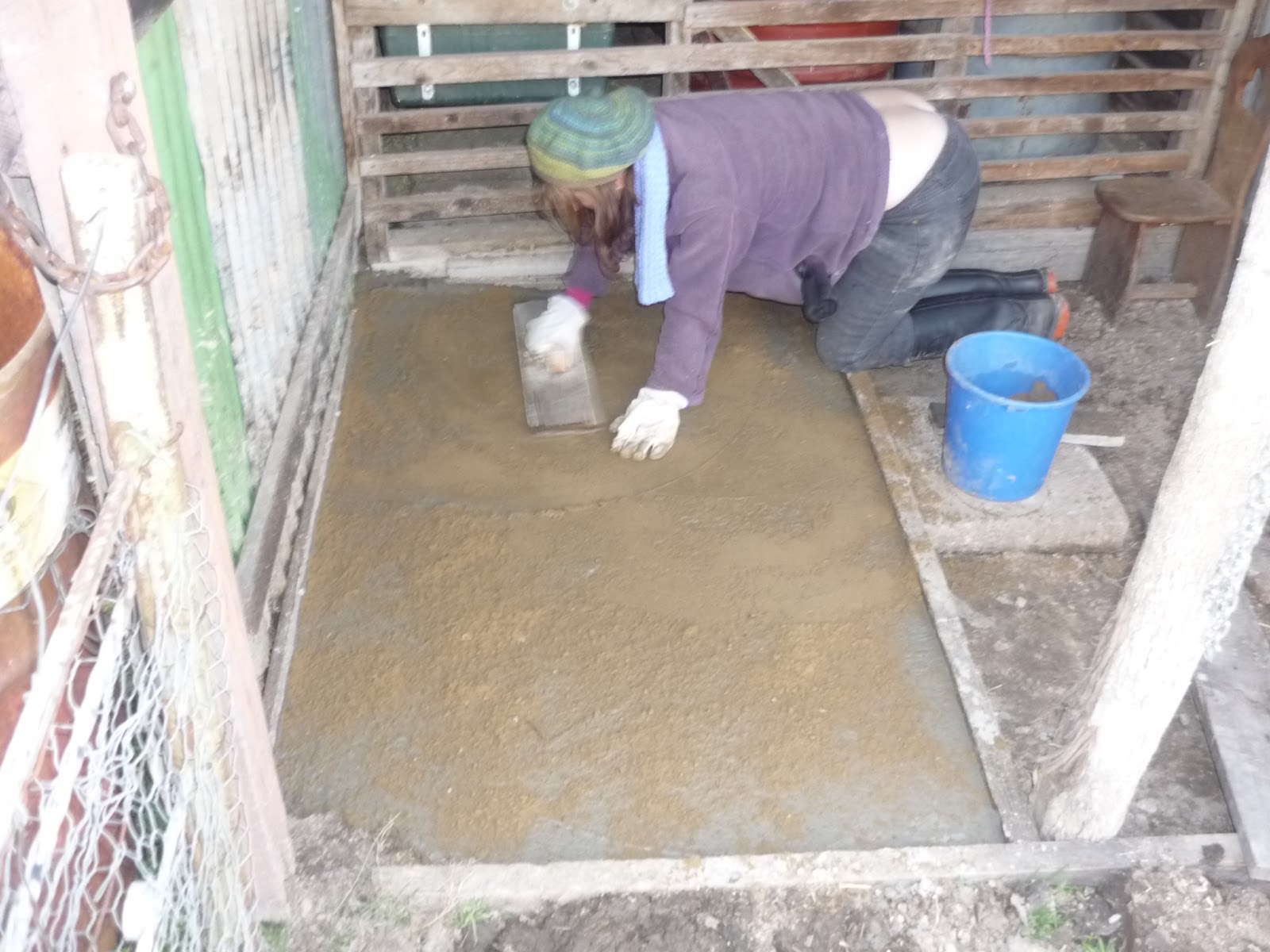
First I dug down to more solid ground and moved out all the soggy smelly mud. Then some wood was attached on all four sides - level across the shed, sloping towards the garden at the front. With some reo cut to size the dairy was ready for some concrete.


Michelle is a concreter's daughter so while I mixed up the bags in the wheelbarrow she brandished the homemade float and smoothed out the wrinkles.

 
Once the concrete had 'gone off'' - that mysterious moment where the chemical reaction in the mix is completed enough to make a lasting finish on the top - she set to work again. It was important not to make it too smooth so Hailey does not slip. A bucket of sand applied to the top and then brushed completed the process and time does the rest. Tomorrow Hailey will have to milked out in the paddock to make sure the slab has set enough to be stood on the next day.


It will be quite something to have a solid floor to work from and being raised up a couple of inches will make Hailey happy as she will be able to access the feed bin easier.
 

Saturday, June 6, 2015

Tonto the Bull

 
We have a guest on Opportunity Farm. He has been invited here to sire Hailey's next calf. Tonto is a young Dexter bull who belongs to our neighbours. They run pedigree Dexters and their line of bulls provide semen for customers all over the world. Last time we needed a bull for Hailey she went to their place but that wouldn't work with milking and Comet the calf. So they kindly lent him to us.
 

Tonto is a gentle boofy-headed boy who seems quite safe to have around people, especially children. He is a little smaller than Hailey so we are hoping he is able to climb high enough to perform a successful service. So far he has checked Hailey out a few times but hasn't been too interested. By day Hailey hangs with Comet but we need to keep the calf separate as she could be old enough to be in season herself - without being big enough to survive the pregnancy. Tonto gets the night shift. This makes it harder to know whether he has done the job he is here for, but I am hoping it will be obvious. Having a mature bull around is new to me so hopefully all goes well - otherwise Tonto may be with us for a fair while.


The 100th Post

100 posts is time to reflect on what we have been doing, why we are doing it and where we are going with it.
 
Since January 1st we (Matthew and Michelle - but mostly Matthew as Michelle has written 154 posts of poems as well) have been recording activities, events and musings about our life here on Opportunity Farm. It has been many parts diary, some parts instruction manual and some parts philosophy. Basically whatever seemed noteworthy about our attempts at homesteading.

The food production side has been a pleasure - tonight for dinner there were two meals, one comprising pumpkin soup and homemade bread while for the fussy ones pork mince, tomato sauce and rice washed down with a raspberry smoothie and a glass of cider (not for the kids!). The only purchased ingredients being the flour and yeast for the bread, the rice and a spoonful of local honey for the smoothie. It is great to be able to celebrate the joy of eating our own produce by sharing it with the world.

Today's tasks of preparing to concrete the dairy floor, putting in the first stump for the shearing shed/workshop, attaching a sculpture to the studio, assisting the farrier, pruning a vine and mulching a garden bed were all practical, physical and also an enjoyable way to spend a Saturday. We blog to share this life with people who may be interested or inspired to follow suit in whatever way they can.

 
Our eventual aim is to have people come and visit us at Opportunity Farm and take advantage of some of the skills and knowledge that we have in supporting children to learn, scouting and homesteading as well as simple practical activities they want to try or practice. We hope to have a list of these activities on a page at the top of this blog soon.

 
The difficulty is getting this blog out there and increasing the number of people who come across it. So far more there have been more than 1000 hits which is a little more than 10 per post. When I publish a post there are 5 hits within a very short time which means there are some who have linked our site to their email. We believe there are a lot more people out there who may enjoy our blog posts if they can find it.

What we haven't had is any comments. We would love to hear your responses and feel more connected to those that have visited this blog. If you link our site to Facebook or any of the other forms of social media it will also increase our profile. This will help inspire us to continue blogging about our life and growing a rewarding and ethical business as well as lots of yummy food. Many thanks to those who have been following us - here's to the next 100!
 
The first day of Winter 2015


Friday, June 5, 2015

The Roof is Off

After three and a half days of dismantling, all the roof from the shearing shed is down. All the decent pieces of tin have been removed to our paddock and the piles of useful timber remain on site to be denailed, trimmed and then driven home.
Removing the shearing plant remains a challenge. It was working well when the shed ceased to be used about thirty years ago. Michelle will be using an electric handpiece to shear our sheep so the plant would only be decorative and suitably authentic. I am going to try to bring down two plants and the flywheel in one piece. However today's efforts ended with the crowbar flying back into my face and chipping my tooth. Having been so careful with all the flapping tin and timber balanced over my head it was a bit of a smack in the face!
Next time I go out there I hope to have the chain saw back from the repair shop as it could prove very handy in dropping the final posts and maybe cutting up some post for firewood.  


Monday, June 1, 2015

First Day of Winter

This morning we woke to the quiet sound of fallen snow. Once there is settled snow it seems to deaden all other sounds. No vehicles on the road adds to the eerie silence. At 5.30am there was a light dusting but it hadn't settled on the paths or roads. An hour later it was blizzarding and settling everywhere. There was not more than an inch in total before it stopped but it was enough to stop the school buses and allow the kids to have some fun with snowballs and snowmen.


Opportunity Farm is at 900m above sea level so snow is common. Many years there will be a couple of dumps but not long ago snowfalls were much more frequent and heavy and the farm would have been cut off for a while each year. Whether this is global warming is uncertain but if you talk to the old-timers they will often say that maybe we will get a real winter this year. This one has certainly got off to a cold start.