Showing posts with label Shearing. Show all posts

Tuesday, January 16, 2018

Week 2 2018


Week 2 2018

This week started really hot, went through thunder and lightning, headed jumper cold with snow down to 1500m and ended in damp drizzle. We pumped up four full tanks of water from the house tank and the dam levels started to go up.

On Monday we collected a WWOOFer from Cooma. Margot, a university student from Paris, was keen to spend some time on the farm and improve her English. WWOOF stands for Willing Workers on Organic Farms and is a great way for travellers to find hosts - free board and lodging in exchange for at least four hours a day labour. I spent many months doing this in Australia, New Zealand and England and learnt a lot. Wwoofers give us the chance to concentrate on a few projects that would be onerous and put off without help and to share our farm and our food with interesting people.


Our two Duroc pigs, Chocolate and Caramel, are no longer piglets and have managed to turn over all the soil in their 12m by 6m pen. It was time to give them a fresh patch. Pigs are homebodies and once they have worked out their patch they can be reluctant to move. They also have a very healthy respect for electric fences so we could remove the outside panels and set them up around the new patch without the pigs escaping. They stayed behind the electric wire until we were almost done. Chocolate is the dominant pig so he went into the new pen happily while we had to chase Caramel to step over the line between old and new pens even though there was no barrier there at all.

The older the pigs get the quicker they turn over the soil and the more often the pen need to be moved. We bought these pigs in November and they are fattening fast - with fallen apples and excess zucchinis gradually replacing the grower pellets. By March they should reach 70 kg and head off for their one bad day.

The next task was to pick the three blackcurrant bushes. With four children and two adults it took about an hour to strip the bushes. We picked just over 4 kg.
 For preserving recipes our go-to book is 'A Year in a Bottle' by Sally Wise and her recipe is:

2 kg blackcurrants, washed, stalks removed
4 cups water
3 kg sugar
60 g butter


After bringing the currants and the water to the boil and cooking for 10 minutes, we added the sugar and cooked until it was dissolved. Then we added the butter and boiled hard until the setting point was reached. 
This made 18 jars (mostly 375 ml ones).

At Opportunity Farm we have four sets of chooks - two in mobile chicken tractors and two in fixed pens. The latter have been used as pens for a long time. Each year we clean them out to remove most of the manure. This manure is very high in nitrogen but needs to be composted before going on the garden. Four full wheelbarrow loads were trundled off to the compost heap and mixed with lawn clippings, waste wool and dried weeds - to be left until spring.


Once the pens were cleaned of poo, we washed down all the walls and surfaces with a dilute solution of a pyrethrum based powder that eradicates and prevents mites. We have only had one outbreak at Opportunity Farm but it seems sensible to be proactive while we are cleaning the pens.

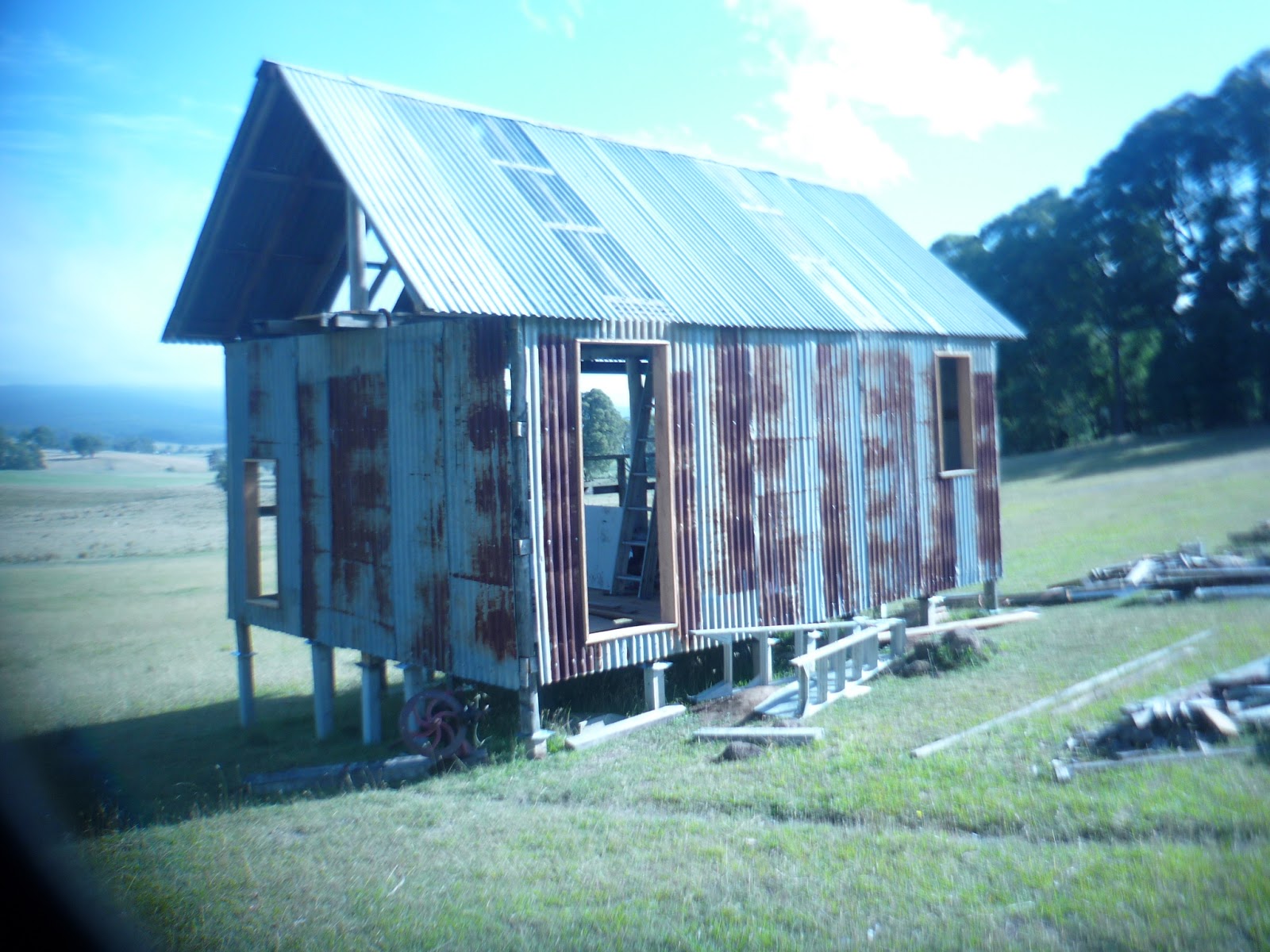
We have been slowly building a shearing shed for our small flock of sheep. The building is almost complete but we need to set up some yards and fencing to direct the sheep into and out of the building. For fencing we needed posts. Our other property has 300 acres of bush and most crucially plenty of red box trees. These have the advantage of being too dense to be eaten by termites and the disadvantage of not being straight. There are plenty of young trees about 20-25cm in diameter. From most such trees it is possible to cut two posts and maybe two stays. The stays are the support posts that angle into the ground from the main post to keep it upright when the fence wires are tightened.
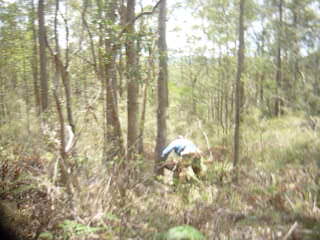

Dropping a Red Box tree to make posts


Trimming the tree to make stays (note the bendy trunk!)

Once the posts were dropped off back at the Farm we dug some holes. Each hole was dug so that a third of each post is in the ground ie a post of 2.1m length goes into a 0.7m hole.

Before we could site all the posts I needed to build a chute. This is a ramp down which the shorn sheep is pushed once shearing has been completed. The chute is about 500mm wide and 1200 high.
I chose to make the ramp out of palings and the walls and roof from corrugated iron. All the components except for the palings came from a collapsed shearing shed a friend allowed us to remove. The round posts were trees cut in the 1950s and now reused 60 years later.
To complete the walls and roof I need some more roofing screws so it will need to be finished later.


Tuesday, July 11, 2017

The Animals of Opportunity Farm - Sheep

The Sheep


The only animals that were on Opportunity Farm when we arrived were a flock of hand-reared Wiltshire Horn sheep. These sheep are hardy and will tolerate poorer pasture, rarely need assistance with birthing and do not require any shearing or crutching.
As we increased the number of other animals on the farm, our flock of Wiltshire Horns has diminished to 12. We currently have one young ram, a wether that has somehow survived the freezer, eight ewes and two lambs.
We also have four other sheep:
Shaun, a Dorset wether who was a poddy whose owners couldn't eat him or look after him and begged us to give him a home. He is large and very friendly and will follow you anywhere if he thinks you have food.
Daisy, a merino coloured sheep who looks like a cow rather than a sheep. She was also a poddied pet and is very friendly. She seems to be barren as she has never had a lamb.
Gerald and Henry are a pair of Corriedale coloured wethers. They are both chocolate in colour and are designed for Michelle to spin their wool. They were brought to Opportunity Farm late in 2016 and the trauma of the journey has made Gerald's fleece snap at that point so currently he is moulting. Henry (named for Henry Lawson) is more confident and hangs out with Daisy and Shaun. Gerald (named for Gerald Durrell) tends to hang near the back with the more anxious sheep.
All the sheep come running when some sheep nuts are shaken and queue up each morning in winter for their lucerne biscuits and nuts.


Monday, February 8, 2016

Shearing Shed Details

 
Shearing Sheds need a pen to hold the sheep about to be shorn. This has a gate that swings both ways so that the shearer can enter the pen, catch and drag out a sheep while the door swings closed. The photo below shows the pen and doors in an abandoned shearing shed near to Opportunity Farm.
 
 
Our shed only needs to cater for a small number of sheep. Our pen can hold about five while more can be brought in through the door via a ramp at the back of the shed. The pen is constructed from materials from the abandoned shed. 

 
The floor of the pen is slatted which allows the urine and the excrement from the sheep to fall to the ground beneath the shed while being solid enough that the sheep don't get their hooves stuck in the gaps.

 
Once the sheep has been dragged out of the pen the floor of the shed where the shearer shears the sheep has to be smooth and solid to ensure that the fleece and other sections of what is shorn can be swept up and that the wool does not catch on rough surfaces. This floor has to be easily and regularly swept so I have used a variety of pine and hardwood tongue and groove flooring. It was not easy to put together as the grooves didn't match, the flooring was a variety of sizes and because the shed is not square the shape of each piece near the edge was unique. 

 
This is the board of our shed. A couple of the planks are darkened as they were rescued from a house that was badly damaged by fire and the flooring coated in soot and ash. Still it all has a new home and a new lease of life.

Monday, February 1, 2016

Spinning up a Yarn at the Shearing Competition

 
Our local town hosted a shearing competition as part of a commemorative weekend of events. To do this they erected a huge marquee and under it built a six stand shearing platform complete with lights and shearing plant, wool table and press.
One of the committee had the bright idea of trying to turn some of the wool shorn into a wearable product in the course of the day. They needed a spinner - Michelle.
We needed our five non-shedding sheep to be shorn. A deal was made. If our sheep were there at the start they would shear them and give us the fleeces. (It is very important not to put coloured wool in with the standard white). Then it was up to Michelle and friends to demonstrate how they did it in the 'old days'.
 
 
Cilla (the Black sheep) and Shaun (the white Dorset) being shorn.

 
Daisy ready for her trim.

 
Harriet (the spotty Merino) and Cilla after shearing.


Robert remembering how well his grandmother taught him to spin with eager watchers.

Those spinning and knitting managed to make about half a jumper in the day and could have done a fair bit more if they hadn't enjoyed sharing knowledge with so many interested visitors. If there is a next time they will be a bit more prepared and may make something less ambitious!

Sunday, January 31, 2016

Finding what we need for the Shearing Shed

 
Our Shearing Shed is almost entirely made from materials recycled from sheds no longer in use and collapsing from old age. Our main source was a shed which had all the internal parts removed leaving a shell that had no integrity and started to fall over. Some of the rusting but solid tin from this shed has now been fixed on three sides of our 'new' shed but we lacked some of vital fittings.
 
Today we hit the jackpot and found a dying shed on a neighbouring property. Some of the roof was missing and it was starting to lean. 
 
 
Despite the dilapidation there was a wool table in decent condition and plenty of internal panelling and gates. For our five sheep we only need two short lengths of wall panels and one gate.


The internal panelling waiting to be removed and rebuilt for a second chance at life.
 

Last year Michelle tried to buy a wool table at a clearing sale but it went for an astronomical price. As she had waited all day with a bunch of hot and bored kids she bid high but in vain. Sometimes the solution is under your nose and only takes a bit of asking the right questions to the right people. We had a great score and the satisfaction of knowing that a piece of local history gets a chance for a new life.

Sunday, October 4, 2015

The Shearing Shed/ Workshop shapes up

 
We dismantled a collapsing shearing shed on a nearby farm. There was plenty of tin, round posts and assorted lengths of timber to be recycled. The aim is to build a shed that we can use to shear our small flock of sheep, hold a workshop in and have some space where visitors can roll out a swag.
 
Working with tree trunks for posts is always challenging as they are rarely straight. We have termites so I did not want to put the posts into the ground. So each post is set on a concrete stump set lower than the stumps that hold up the bearers for the floor joists. By chiseling out each post where it meets the sub-floor each of the nine large posts can be locked in and the frame is stronger.
 
 
The south facing wall has a doorway framed with straight timber which will be where the sheep enter the shed to go into a holding pen. The pulleys and rods seen through the doorway are an authentic working shearing plant from the original shed. This will be mounted on the west wall but will be for aesthetic reasons only - Michelle will shear with an electric handpiece powered by a generator. By recycling the tin and timber and framing the shed with round poles we hope it feels as if it has been there for a while.

 
There is a big window to go in the north facing wall which is not a feature of an original shed but should let plenty of light in and allow visitors a good view down the valley. Plenty of work to go but the project is at an exciting stage where the shape and feel of the shed is emerging.

Wednesday, May 13, 2015

Dealing with Flossie

Poor Flossie had fallen on hard times, but hopefully she has turned a corner and things are looking up now that she has joined us at Opportunity Farm. She was once  a much loved pet. She is very friendly and comes up for food or a scratch. When you have food for her she runs around chasing her tail like a dog with excitement.
 
For the last year or so her coat's needs have been sadly neglected. It is long, bedraggled and in places dreadlocked. Besides a great deal of sand in its locks there are no seeds or burrs. So the paddocks she has been kept in have been pretty clean of weeds. At some time one of her back legs has been broken, and then set again crooked. She walks with a limp. Her hooves at the end of her twisted leg have grown sideways. When we first saw this hoof in particular, we thought that her hooves had not been trimmed in a long time. But besides this damaged foot they were in pretty good shape.
 
Today we are tidying her up. To shear her matted coat Michelle uses the hand shears. They only cut well when the blade is at the right angle. It is slow work. Flossie is pretty calm overall but gets much more agitated when the blades get near her bottom or her damaged leg.  When we cut around her face she closes her eyes and stands the most calm as if 'blissed out'. For the various higher maintenance areas we try various positions and angles: standing over, kneeling or sitting beside. Michelle tips her just like a sheep but she doesn't stay in the position. Standing over her is the easiest, starting from her backbone. Slowly the blades move down the sides leaving a trail of tangled ringlets still attached and trailing. It takes about two hours to complete her coiffure and tidy her toes. We made a coat for her so that the shock of losing all her insulation would not be too great, but she got it off in minutes. So into the warm goat barn she goes. She is on her own for the next little while until she gets used to her new look and we decide who would be the nicest goat friends for her to hang out with.